Sound Familiar?
Most tribunals are still stuck with outdated tools that create more work, not less.
Drowning in Paper
Filing cabinets full of cases. Hours spent searching for documents. No way to see the big picture.
Cases Falling Through
Missing follow-ups. Forgotten questionnaires. Cases that sit idle for months because no one tracked the next step.
Manual Everything
Typing the same information over and over. No automation. Every status update requires a phone call or email.
There's a better way. We built it.
Everything Your Tribunal Needs
Not adapted from generic software. Designed from day one around how tribunals actually work.
Automated Workflows
Cases move forward automatically. Status changes trigger tasks, notifications, and reminders — so nothing falls through the cracks.
Online Questionnaires
Petitioners, respondents, and witnesses complete forms securely online. Auto-save, reminders, and instant notification when complete.
Complete Case Tracking
Every case from inquiry through decree. Full timeline, documents, notes, and communications in one place.
Canon Law Compliant
Workflows built around the 1983 Code of Canon Law. Every status matches the canonical process for declarations of nullity.
Secure & Private
Handled under the secret of office (Canon 1455): per-diocese isolation, role-based access, and encryption. And a rule we don’t bend — your case data is never used to train AI models.
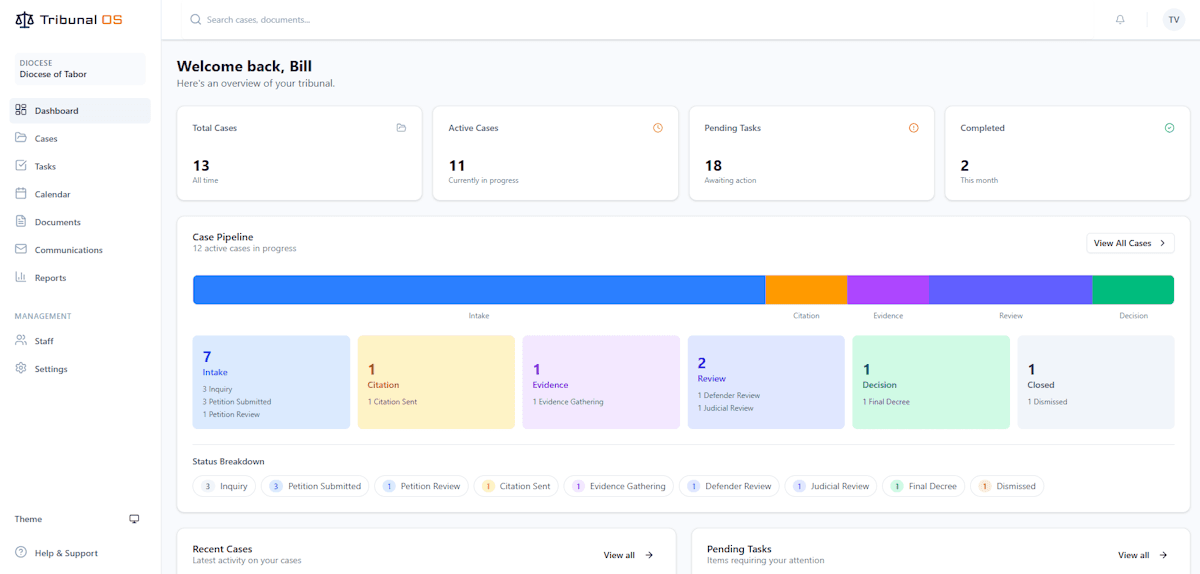
Visual Pipeline
See all your cases at a glance. Know exactly where each case stands and what needs attention today.
An AI Clerk, Not a Judge
Optional AI drafts deposition questions, cleans recorded transcripts, and organizes the facts by ground for the Defender of the Bond. Every output is a draft a canonist reviews and signs — it never renders a decision, and the case data never trains a model.
In his 2026 encyclical Magnifica Humanitas, Pope Leo XIV asked that technology “help us anticipate and organize… without undermining human freedom and judgment,” and that “the irreplaceable role of the individual must remain the general rule.”
Tribunal OS was built that way from the start. The AI assists the tribunal’s work; the tribunal’s people keep every canonical judgment. A declaration of nullity is a judgment about a person’s life — it belongs to the judge, never to a machine.
How Tribunal OS Works
The canonical process, digitized and automated. Every step follows Church law.
Petition & Intake
Receive inquiries, create cases, and send citation to the respondent. Automated notifications keep parties informed.
Evidence Gathering
Send questionnaires to parties and witnesses. Track responses in real-time with automatic reminders.
Review & Decision
Defender of the Bond and Judge(s) review all evidence. Tasks auto-generated at each stage.
Decree & Closure
Render decision, manage the appeal period, and issue final decree. Complete audit trail preserved.
See Tribunal OS in Action
Watch a quick walkthrough of how Tribunal OS can transform your tribunal operations.
Built Different
Other solutions were adapted for tribunals. We were purpose-built.
- ✕Generic case management adapted for tribunals
- ✕Manual status updates and follow-ups
- ✕Paper forms mailed back and forth
- ✕Cases lost in filing cabinets
- ✕No visibility into case pipeline
- ✕IT department needed for updates
- Purpose-built for Catholic tribunals
- Automated workflows move cases forward
- Online questionnaires with auto-reminders
- Everything searchable and organized
- Visual pipeline shows all cases at once
- Cloud-based, always up to date
Common Questions
What tribunals and diocesan IT directors ask us first.
- What is Tribunal OS?
- Tribunal OS is case management software built specifically for Catholic diocesan marriage tribunals. It tracks a declaration of nullity from the petition through to the sentence, enforcing the canonical process at each step: the required documents, the personnel who must be seated, the decrees that must issue, and the waiting periods the law requires.
- Who is Tribunal OS for?
- It is for the tribunal of a Catholic diocese: the judicial vicar, the judges, the defender of the bond, the notaries and the advocates who work its cases. It is not consumer software and it is not for petitioners to run their own case.
- Is Tribunal OS available now?
- Not yet. It is in active development and under review by practicing canonists, and it will not be released or opened for beta until they say it is canonically sound. You can join the waitlist to be told when that changes.
- Does it support both the ordinary process and the processus brevior?
- Yes. The ordinary process and the briefer process before the bishop are separate workflows with their own stages and their own prerequisites, because they are separate processes in law. Documentary and privilege processes are supported as well.
- Can we migrate our cases from CaseMaster or Canonical?
- It depends entirely on what your current system will export, and nobody should promise otherwise without having seen it. Send us an export and we will tell you honestly what can be carried across and what cannot.
- How does Tribunal OS handle canonical time limits?
- It enforces them rather than reminding you about them. The respondent’s fifteen days under c. 1676 §1, the ten days to challenge the dubium under c. 1513 §3, the fifteen-day review of the acts under c. 1598 §1 and the appeal period under c. 1630 all block a case from advancing until they have genuinely elapsed. There is no override.
- Does Tribunal OS use artificial intelligence, and does it decide cases?
- It never decides anything. Three optional assists help with clerical work: drafting deposition questions, cleaning a raw transcript into readable question and answer, and organising the facts by ground into a digest for the defender of the bond. Each one produces a draft a person reads and signs. The software renders no judgment on the merits of a cause.
- Where is tribunal data stored, and who can see it?
- Data is held in an encrypted cloud database, isolated per diocese, and no diocese can see another diocese’s cases. Within a diocese, access follows the seat a person holds on a given case, so a notary or advocate sees the causes they are assigned to rather than everything.
Be Among the First
We're onboarding a select group of dioceses during our early access period. Join the waitlist to get priority access and founding member benefits.
We'll reach out within 48 hours to schedule a demo.